

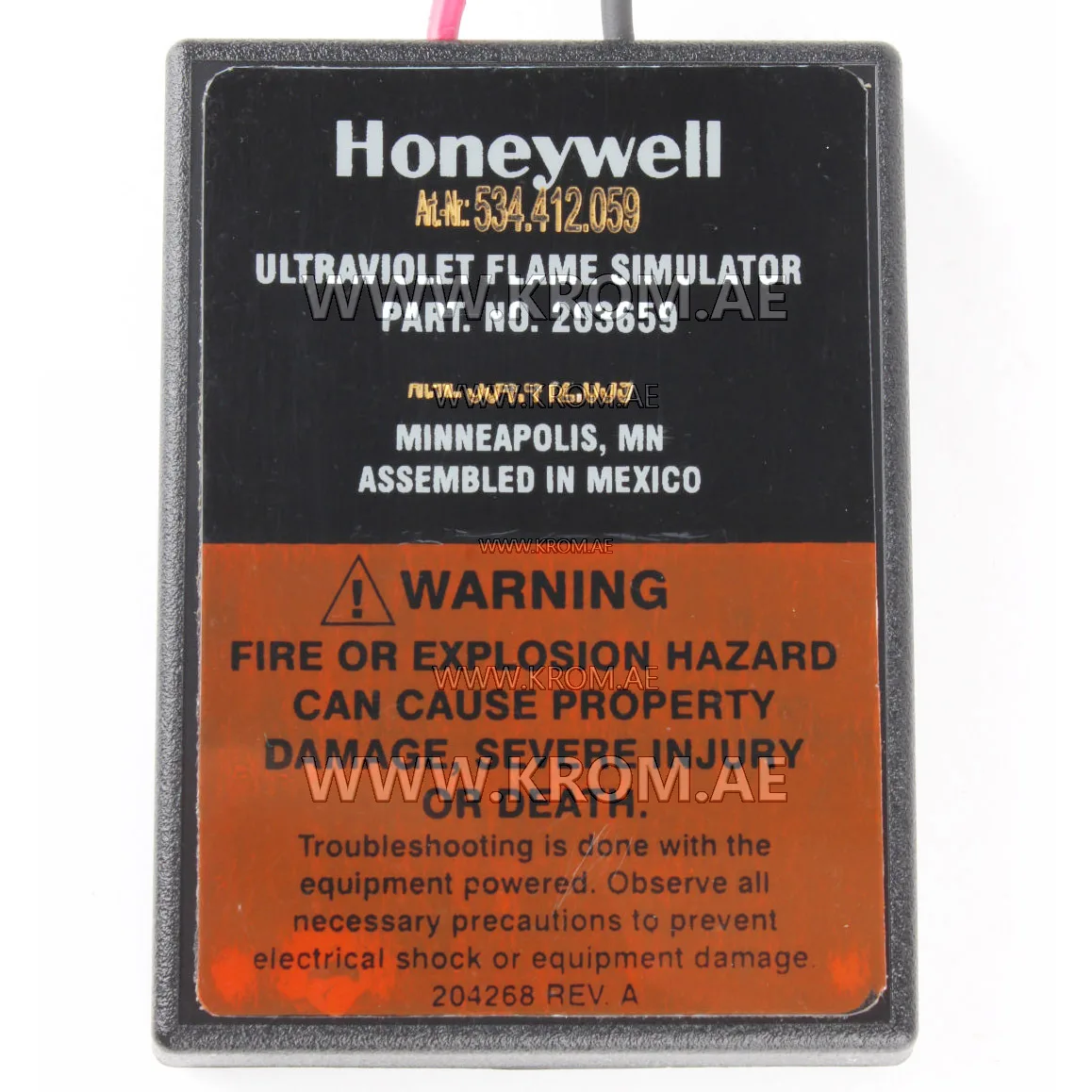
Honeywell 203659U UV flame simulator
A UV flame simulator is a testing tool used to generate a simulated ultraviolet flame signal for a burner control (flame safeguard) that relies on a UV detector for flame proving. During commissioning, troubleshooting or routine maintenance, a technician can connect the simulator in place of the actual UV scanner to verify that the control recognises a flame signal within the correct safety time and responds accordingly. The simulator typically plugs into the same wiring or socket as the UV detector and emits a pulsed UV output that mimics the radiation from a real flame. It is not a permanent component of the burner system but a diagnostic accessory. Parts of this type are selected by the connector pattern and signal format that match the specific burner control series. Different controls may require a simulator that generates a specific frequency or pulse train, and the supply voltage (often taken from the control itself) must be within the simulator’s rating. When replacing a UV flame simulator, confirm that the output characteristics and connection are compatible with the control model – a mismatch can cause the control to fail to detect the simulated flame or to lock out unexpectedly. Some simulators are designed for a single control series, while others are adjustable; the manufacturer’s documentation for the control will specify the correct simulator type. For safe use, the simulator should be removed and the actual UV detector reinstalled before the burner is returned to normal operation. Leaving a simulator in place would defeat the safety function of the flame detection circuit. Always check that the simulator is rated for the voltage present on the detector terminals, and never use it on a control that does not explicitly list it as an approved accessory, as the control may interpret an incorrect signal as a fault.