

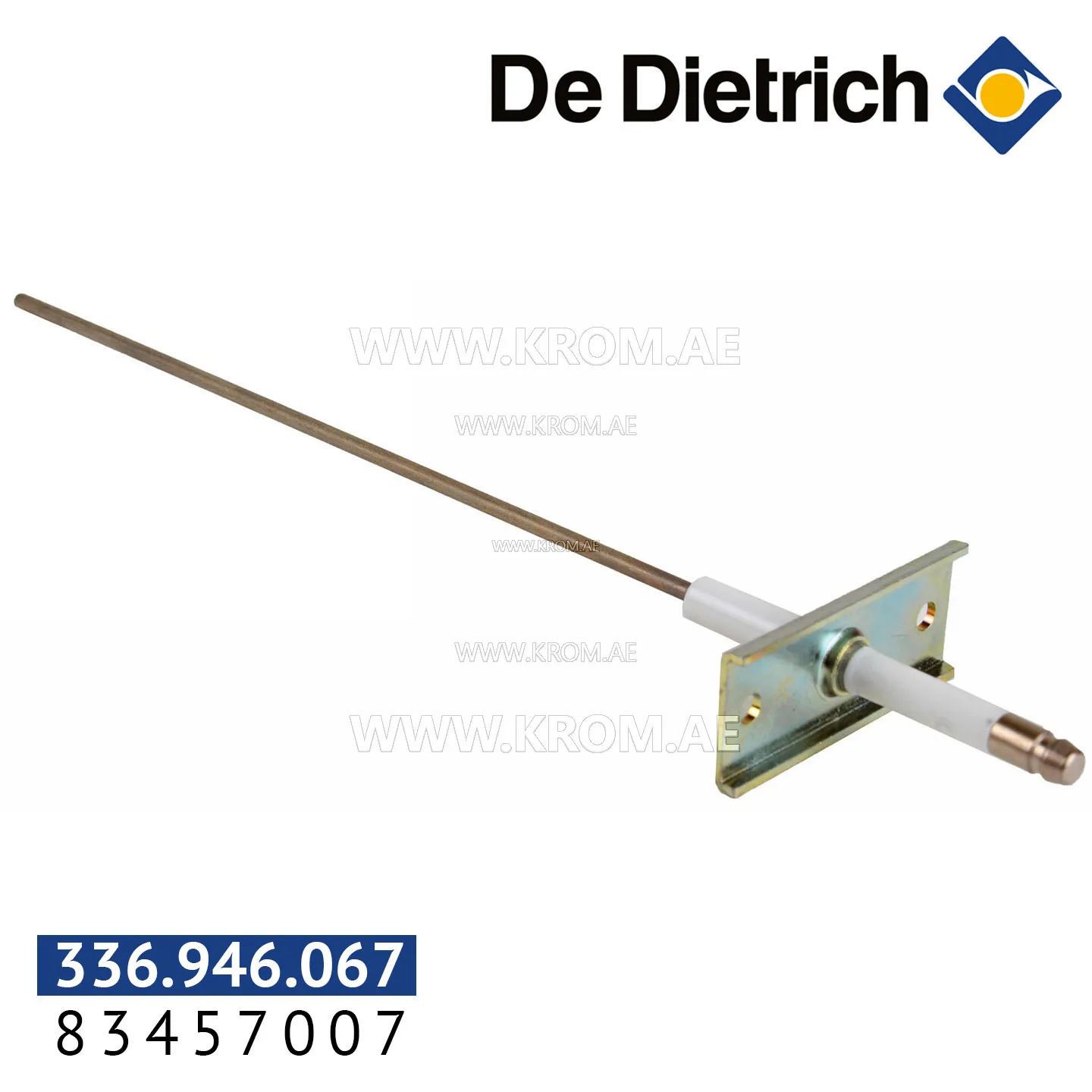
De Dietrich 83457007 ionisation sensor
The De Dietrich 83457007 is an ionisation sensor, listed under the Ionization & ignition electrodes category. Parts of this type are also referred to as ionisation electrodes or flame rods. Their function is to prove the presence of a flame during the burner safety sequence. Once the ignition spark has lit the fuel-air mixture, the ionisation electrode is immersed in the flame and conducts a small rectified electrical current through it. The burner control (flame safeguard) monitors this current; if the signal is lost, the control locks out the burner within the safety time. Unlike ignition electrodes, which produce the spark, ionisation electrodes only sense the flame and are continuously exposed to the combustion zone. Ionisation electrodes are consumable items. Over time the tip erodes, the ceramic insulator may crack from thermal shock, and soot deposits can insulate the electrode and weaken the flame signal. These failures typically result in nuisance lockouts or delayed ignition. When replacing an ionisation electrode, the critical selection parameters include the overall length and bend of the rod, the insulator diameter, the gap between electrode tip and burner earth (or pilot burner body), and the mounting flange type. The exact shape is matched to the burner design and the position of the flame relative to the electrode. On burners equipped with a pilot burner, the ionisation electrode is usually positioned so that the pilot flame provides the signal, which in turn proves the main flame indirectly. It is important to use a genuine replacement that matches the original dimensions and mounting arrangement, as an incorrect gap or length may prevent reliable flame detection or cause the electrode to short against the burner metalwork.