

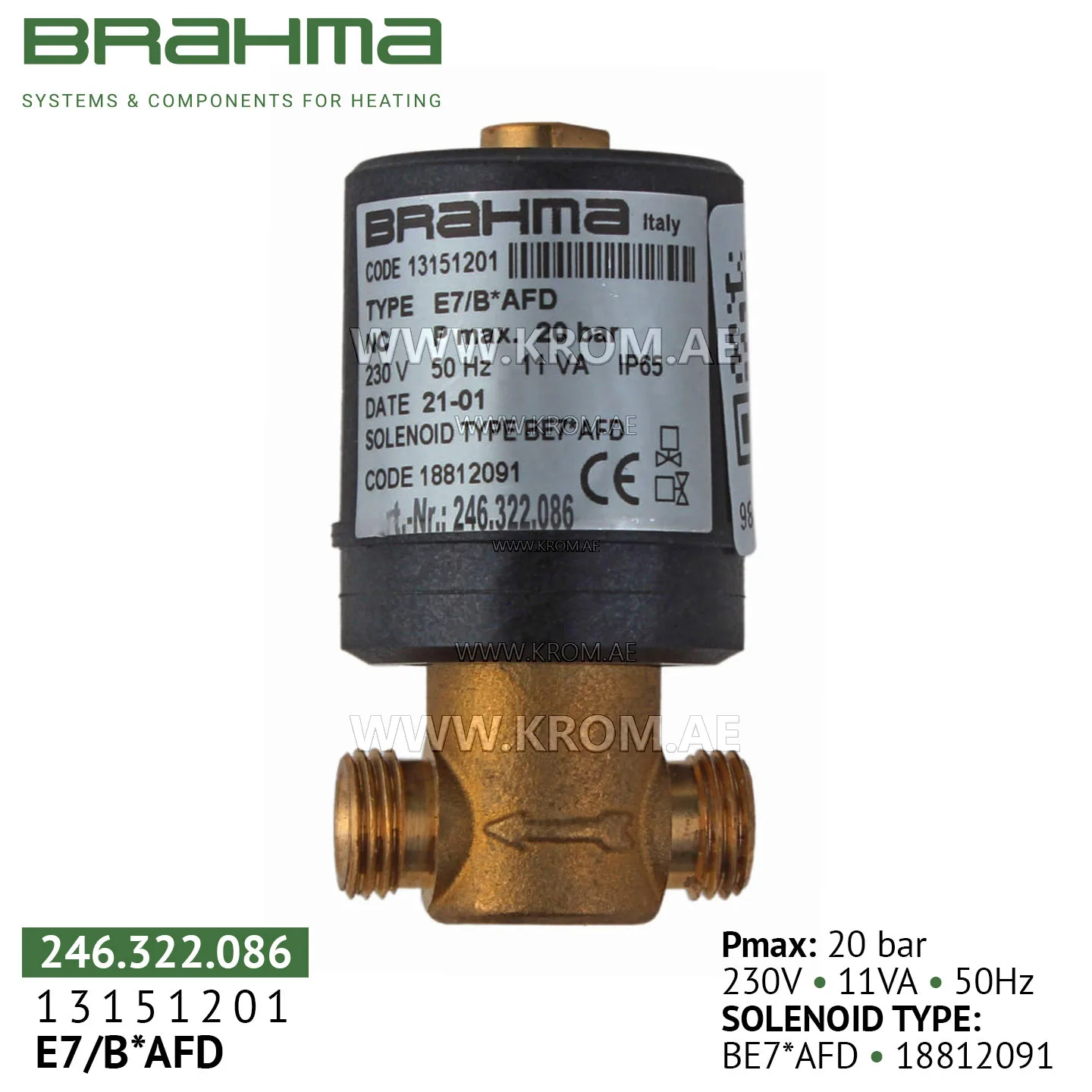
Brahma 13151201 E7/B*Valvola dell'olio AFD
The E7/B*AFD 13151201 valves are designed for light liquid fuels. These magnetic valves E7/B*AFD 13151201, normally closed type, have a fast response and are used in both domestic and industrial installations, operating on both direct and alternating current. The E7/B*AFD 13151201 oil valves are available in various versions, which simplifies assembly and eliminates the need for a large number of connecting parts, thereby increasing the reliability of the design. Technical data: - Supply voltage: 230 V / 50 Hz - Working pressure: 0-20 bar (nozzle ø1.5 mm) - Ambient temperature: 0 - 60 °C - Maximum fuel temperature: 80 °C - Opening and closing time: <= 1 sec - Power Consumption: 11 VA - Consumption: 0.055 m3/h - Weight: 230 g - Installation position: any - Body: brass - Input: G1/4”M - Output: G1/4”M - Winding type: alternating current - Connection: quick-release connection for DIN 43650-IP 65 Installation: The installation is carried out in accordance with national and European standards (e.g. EN 60335-1) for electrical safety. The installation must ensure that the Brahma E7/B*AFD 13151201 solenoid valve body is connected to the ground to provide adequate protection against electric shock (EN 60335-1). Install the Brahma E7/B*AFD 13151201 magnetic valve body so that the arrow on the valve body coincides with the flow direction. When installing the Brahma E7/B*AFD 13151201 oil valve on the pipeline, avoid dislodging the protective shell and always use an appropriately sized hex wrench. Make sure that no foreign objects have entered the Brahma E7/B*AFD 13151201 oil valve. Connect the filter to the valve inlet (the cell size of the filter element should not exceed 0.5 mm). Check the reliability of the grounding. Make sure that the pressure at the valve inlet does not exceed the pressure indicated on the valve. Checking at startup: Check the Brahma E7/B*AFD 13151201 solenoid valve at the first start, after repair or long system downtime. In particular, check the tightness of the pipeline connection and the valve inlet, check the opening and closing in accordance with the signals coming to the valve coil.